
Can Meniere's disease go away? It cannot be cured yet. The NIDCD and the NHS both say so. But the vertigo attacks often do fade. A 2010 review of 46 studies (7,852 patients) found that attacks become less frequent within 5-10 years.
What usually stays is the ear damage: hearing loss and tinnitus. So the honest answer has two parts. The spinning often settles down. The hearing usually does not come back.
Does Meniere's disease go away on its own?
For vertigo, often yes, given time. Three sets of numbers point the same way:
- The 2010 review by Huppert, Strupp and Brandt pooled 46 mostly retrospective studies. Attack frequency fell within 5-10 years.
- A study of 510 patients from 8 specialist centres found that attacks were most frequent in the first years and fell during follow-up. Many people reached a steady phase with no vertigo.
- A 2024 Dutch study followed 35 people whose attacks had not stopped despite at least two steroid injections. 21 of 33 (64%) were attack-free by the time data were collected, after a median of 5.3 years with the disease.
The Dutch group is worth a second look. These were people on a waiting list for surgery because nothing else had worked. 80% of them (28 of 35) had not had the operation when the data were collected. The same paper cites an older study by Silverstein and colleagues of people who declined surgery: after more than 3 years, 71% were free of attacks.
These are small, mostly look-back studies, and "attack-free" was measured at one point in time. They describe groups. They cannot tell you when your own attacks will slow down.
Umut, who builds Menieres, has had Meniere's disease for about a year. That is the early stretch these studies describe as the busiest one. One person's first year does not predict their next ten, and neither do the averages.
Why "burned out" is not the same as cured
People often say Meniere's "burns out". In the studies, that mostly means the attacks stopped. The ear does not reset.
In the 2024 Dutch study, 21 people were attack-free. Of those, 20 still had hearing loss, 14 had tinnitus, 11 felt unsteady and 5 had ear fullness. Hearing in the affected ear fell by 10.5 dB on average over follow-up. The other ear changed by 2.4 dB.
The 2010 review puts the long-term numbers at a hearing loss of about 50-60 dB and a 35-50% drop in balance-organ function. Most of it happens in the first 5-10 years. The NHS says that over time hearing may gradually get worse and tinnitus may become constant.
The loss often starts at the deep pitches. The Cleveland Clinic says many people first have trouble hearing lower pitches. Umut's own hearing test has shown low-frequency hearing loss in the affected ear. The guide to low-frequency hearing loss explains how that looks on an audiogram, and the post on the stages of Meniere's disease explains the hearing stage on a clinic report.
Unsteadiness between attacks is also common, even when the spinning has stopped. The post on imbalance between attacks covers why it lingers and where vestibular rehab fits.
Can it come back after years without attacks?
It can. The Cleveland Clinic puts it bluntly: Meniere's may go away for months or years, but it always comes back. The studies are more hopeful than "always", but they do not promise a quiet spell will last.
- Quiet years are common. In the 510-patient study, 70% of people who went a full year without vertigo stayed free the following year.
- So are returns. The same figure means about 3 in 10 had vertigo again within that next year.
- Attacks come in clusters. The NIDCD notes that some people have single attacks separated by long periods, while others have many attacks over a few days.
That clustering is why a good month, or a bad one, says little on its own. The post on how long Meniere's attacks last covers the phases of a single attack.
Can the other ear be affected?
Yes, and the chance grows with time. The NIDCD says both ears are affected in 15% to 25% of people. The 2010 review found higher figures in long follow-up: up to 35% within 10 years and up to 47% within 20 years.
The studies differ in who they followed and for how long, which is why the numbers vary. New fullness, tinnitus or muffled hearing in the other ear is worth raising with your ENT.
Does treatment make Meniere's go away?
No treatment is a cure. The NHS says treatment can help the symptoms, and the NIDCD lists the options, from diet changes to injections and surgery. Some of them control vertigo with a trade-off:
- Gentamicin injections into the middle ear help control vertigo, but raise the risk of hearing loss, according to the NIDCD.
- Steroid injections often reduce dizziness, with little to no risk of hearing loss.
- Surgery may be offered when all other treatments have failed to relieve dizziness.
The natural course also makes treatments hard to judge. If attacks often fade on their own, whatever someone tried last tends to get the credit. The post on what Meniere's treatment trials actually show explains why placebo groups in these trials improve so much. Which option fits you is a conversation for your ENT.
What to track while the pattern shows itself
Whether your attacks are fading is a question your own records can answer better than memory. Useful things to note:
- Each attack: date, start time and how long the spinning lasted.
- Attack-free stretches: how long since the last one, so a quiet spell has a number.
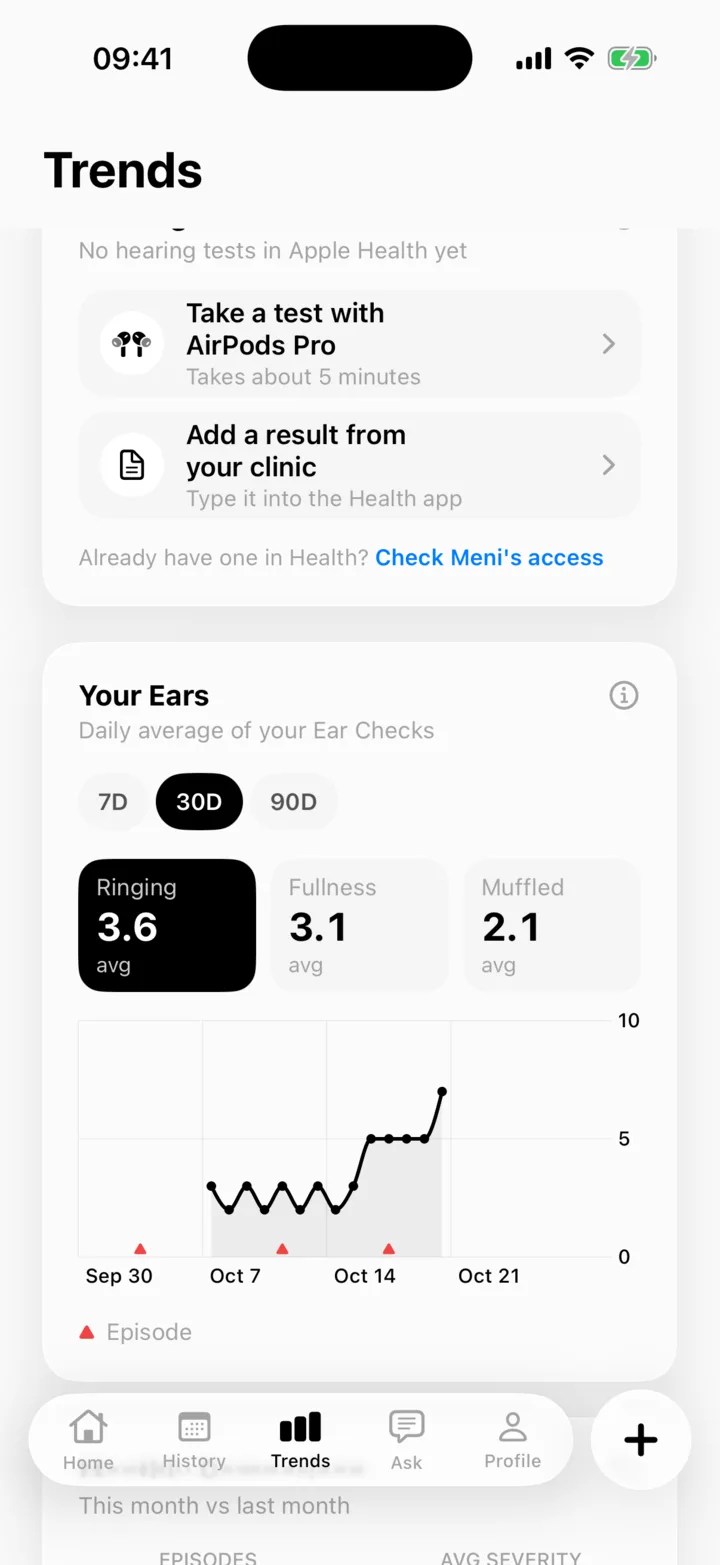
- Ear symptoms: ringing, fullness and muffled hearing, rated 0-10 each day, for each ear.
- Hearing tests: copies of every audiogram, since the hearing can change while the attacks fade.
- The other ear: any new symptoms on that side, with the date they started.
The printable symptom diary works for this on paper. If you test at home as well, the post on the AirPods Pro Hearing Test covers how to keep repeat tests comparable.
Common questions
How long until Meniere's burns out?
There is no fixed timeline. On average, the 2010 review found attacks became less frequent within 5-10 years. Some people reach long attack-free spells sooner and some later.
Can Meniere's disease come and go?
Yes. The NIDCD describes single attacks separated by long periods in some people, and clusters of attacks over several days in others. Quiet months do not always mean it is over.
Will I need surgery?
Surgery is usually a last step. The NIDCD says it may be recommended when all other treatments have failed. In the 2024 Dutch study, 80% of people already on a surgery waiting list had not had the operation by the time the data were collected.